
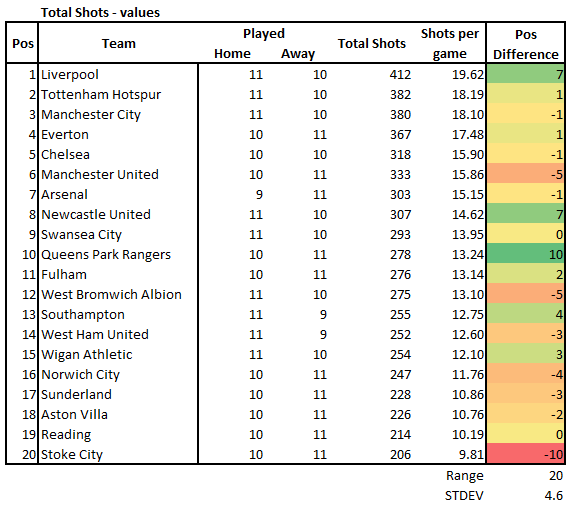
In this post I have published a few simple Premier League team stats with consideration to the insight they provide in relation to the current league table. It can be an interesting exercise to review certain measures and analyse their efficacy in explaining team performance. These types of stats should be taken with a decent pinch of salt, because at this stage in the season (and even after 38 games) the statistics are dynamic and the sample size is small – team averages are constantly evolving and prone to ‘anomalous’ results, such as the 8-0 win by Chelsea over Aston Villa, which has had a significant effect on goal difference. For the purposes of this post, I have made no attempt to smooth or adjust uncommon results.
Premier League Total Shots
Let’s start off simply by looking at total shots. This includes shots on target, off target, speculative long range efforts, blocked shots and even scuffed shots that go out for a throw in.

I have included how many home and away games each team has played because it can matter to the mean values for this sample size. For example, Arsenal have played the fewest home games with 9. At home they average 17.3 shots per game, while away from home they manage 13.4, a difference of about 4 shots.
As we can see from the table, Liverpool are currently the undisputed shot-taking champions with 1.4 shots per game more than second-placed Tottenham. Stoke on the other hand lie bottom and take on average only 9.8 shots per game.
The biggest outliers when compared to the league table are Stoke and QPR, whose positions are reversed. We can see quite clearly from this strange result that total shots is not a good indicator of, say, the quality of shots taken, as Stoke have actually scored 4 more goals than QPR so far this season, despite having taken only 206 shots compared to QPR’s 278.
Premier League Total Shots on Target
The table of shots on target improves the correlation with the actual league table slightly:

Liverpool, first-placed in the total shots table, slip to 5th here, and the top 7 would seem quite reasonable to the casual observer (perhaps in a different order). However, Newcastle outperform their league position again by 7 places and we have a similar ‘anomaly’ between QPR and Stoke, just as before. Perhaps Newcastle and QPR have been unlucky and Stoke and WBA lucky? Well, of course we can’t seriously infer that as we are not incorporating any form of defensive strength into this table. Stoke, for example, have conceded fewer goals at home than any other team. This leads to the next table:
Premier League Total Shots On Target For – Against
This is a shots on target difference table, to show the difference between average shots on target for minus shots on target conceded for each team:

Note that the range and standard deviation of our difference to the actual league table has dropped moderately, suggesting that this table provides the closest indication of league table performance so far. Interestingly, on average, teams below 7th place all concede more shots on target than they have made. Again there are outliers: Newcastle stubbornly insist on taking 8th place throughout these tables, despite their league table position of 15th. The missing ingredient to make the leap to the actual league table is of course the goals scored and conceded themselves. So this table suggests that the teams who are better off in the actual league table have:
- Created more high quality shots
- Been more clinical at converting their shots
- Stifled the opposition attack into having worse shots
- Relied on good goalkeeping to save shots on target
For example, Manchester City and Manchester United have both had 68 big chances this season. United have scored 30, whilst City have scored 25. This shows United’s slight edge over City so far this season in terms of clinical finishing. When it comes to big chances conceded, the opposition have converted 10 big chances against United compared to 9 against City. So the overall goal difference just from big chances is +4 in United’s favour, a small number which nonetheless remains significant after 21 games.
Premier League Goal Difference Table
The last table in the post considers goal difference:
 From the goal difference table we see the impact of the 8-0 loss to Aston Villa’s position. Otherwise the table broadly tells the story of the league table itself which in itself is quite unsurprising, give or take the odd shuffle here and there.
All of the stats from this article have been taken from the Opta Stats Centre at EPLIndex.com – Subscribe Now (Includes author privileges!) Check out our new Top Stats feature on the Stats Centre which allows you to compare all players in the league & read about new additions to the stats centre.

