
Liverpool’s game against Fulham demonstrated, in my opinion, the highest level of performance under Brendan Rodgers to date – and not because of the 4 – 0 score line, but because of the way in which the players executed the phases of play that Rodgers and his coaching staff propose to the Liverpool players every day at Melwood.
Much of the content in the following article includes themes, concepts and ideas that are discussed in the tiki-taka handbook (*due release February 2013 in two parts), and some of the quotes or concepts mentioned in this article are directly taken from personal interviews (Liverpool FC, Barcelona B, Barcelona-USA and a number of other coaches in the game – some of who cannot be quoted here as permission is only given for the book).
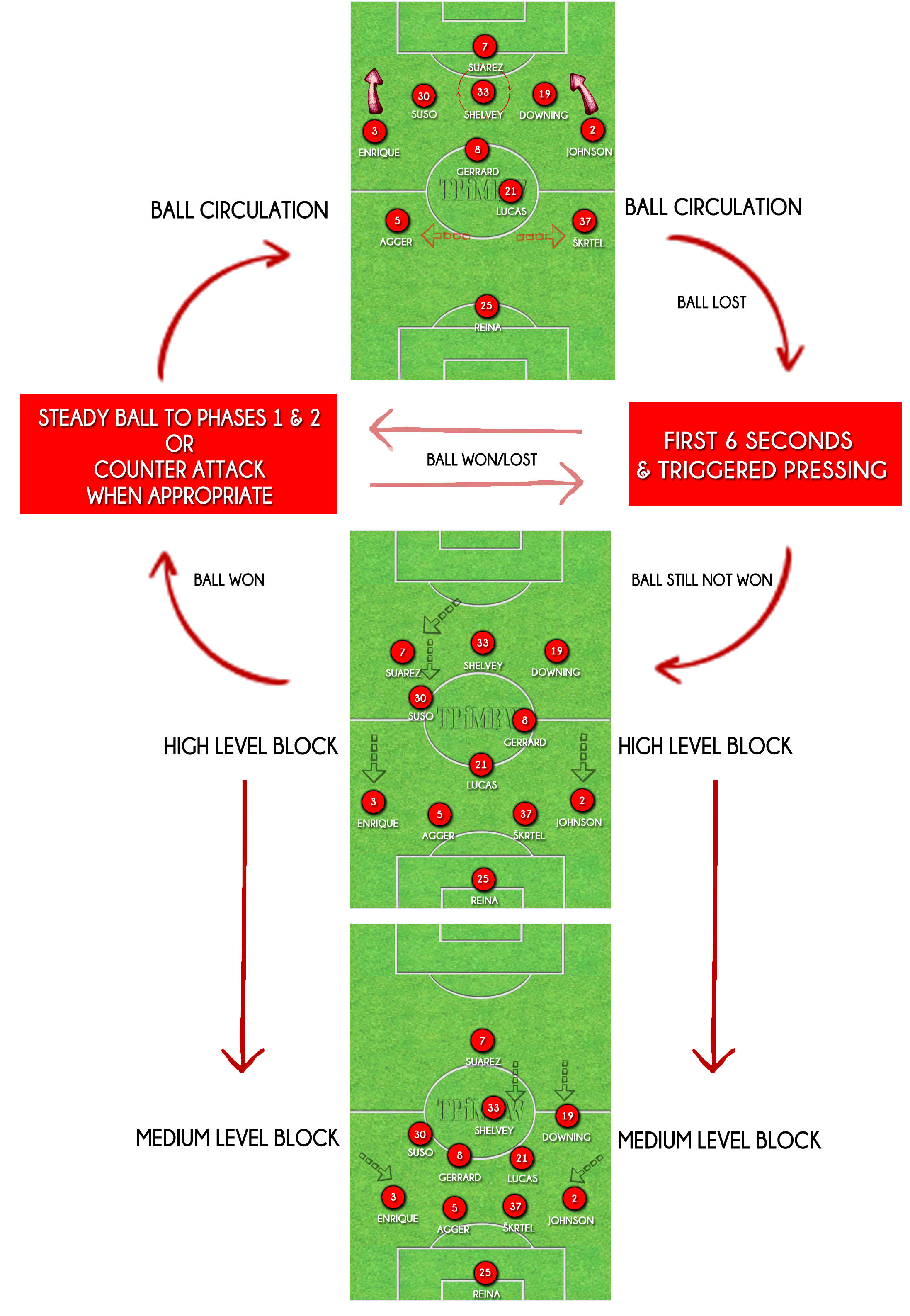
Liverpool and their coaching staff propose a system of play that works around four phases:
- ball circulation
- positioning without the ball [otherwise known as the block]
- the transition of losing the ball
- the transition of winning the ball.
Each of these four states are purposefully isolated and put back together at Melwood under the guidance of Brendan Rodgers, Mike Marsh and co. I consider these four phases to be part of a footballing ‘ecosystem’ that is brought to life during the course of a game.
One way in which Liverpool aim to thrive within this ecosystem is by exploiting formation changes within a game to deal with each of the states listed above. For example, Liverpool do not play with a static 4-3-3 (or 4-2-3-1) formation, as almost every pundit will suggest. In fact the only time Liverpool slipped into anything of the sort (against Fulham) was when they were in their most defensive state (the medium-level block).
So instead of immediately introducing you to the formations that Liverpool employed to facilitate their ecosystem of play (the four phases) and their relationship to one another, I want you to envisage the concept of a formation and how you should decide what formation your team plays. I haven’t played football for a season or two, but the last team that I played for (a Gloucestershire County Football League side – a good standard at the top end of the amateur levels) the approach to formation was simply one of 4-4-2 in which players should reposition themselves back into the three lines whenever possible after being directly involved in a function of play (i.e. a winger running down the wing or full-back overlapping etc).
This leads to a way of playing in which the players are the agent of change. That is to say, if the manager felt a team had a particular tactical issue (not keeping the ball well enough), then it would mean a substitution would be the method to change the game. Therefore the static formation is one based on functional rationale and is a relatively non-adaptable strategy. This quite literally is a ‘form(ation) follows function’ (a famous architectural philosophy) approach to football, one where we start by having fixed ideas about how a team should cater specific functions of play.
Brendan Rodgers, his coaching staff and many others within football have instead opted to go for an alternative approach, one which Mick Pearce (one of my favourite architects) employs, a system of design where ‘form follows process’ and his does this to empower adaptability in design.
If the processes of football are each of the four phases introduced earlier in the article then the functions are the individual isolated parts of the game like crossing, a through ball etc. Some teams really do design their strategy of play around a fast winger and towering striker up front to ‘get on the end of it’. By opting for the alternative, you have a system of play where the formation is the agent of change rather than the players. In other words, if you can’t get a grip on possession, you can drop a central midfielder back into a deeper role as a secondary controller (as the Liverpool coaching staff put it to me on my visit to Melwood in November) – Lucas and Gerrard against Fulham or Busquets and Xavi against Manchester United in the 2009 Champions League final (a game where Xavi was purposefully dropped back to regain control of the ball). By dropping a player deeper you leave the opposition with a choice – to push on and still mark the player closely and leave a one-on-one situation further behind or allow the player who has dropped deep with the space.
This article will focus only on the positioning and formation changes that occur within the ‘form follows process’ approach to football. Barcelona, who also play with a ‘form follows process’ approach, are incredibly successful in the transitional phases, and the quicker a team can work through these transitions (i.e. the quicker a team can press or regain control of the ball) the more successful the team will be at being in the correct positions to either circulate the ball or set up their block (not to be confused with ‘parking the bus!’).
Gareth Richards (a coach who studied at La Masia)
The two phases of ball circulation and setting up the block are anything but simple solutions and there are thousands of approaches to each of these processes. Sometimes in games we will see two different types of block being used, as we did against Fulham. Against Fulham, Liverpool pressed immediately on losing the ball and depending on where possession was lost, they slipped into one of two types of block (high or medium level blocks – both seen in the eco-system diagram in this article).
Liverpool would then be disciplined in their block and press only when one of the many triggers occurred (i.e. a Fulham player momentarily loses control of the ball). Upon winning the ball back, Liverpool would significantly change formation and work through the transitions into the desired ball circulation state further up field – the central defenders would spread right out onto the touch lines, the full-backs would become wingers, one controller in central midfield would drift in and out of the centre back role and so on. The second goal Liverpool scored, was an absolute masterclass in how the transition from a block to the attacking phases of ball circulation can lead to an unstoppable level of off-ball movement as players drive on forward.
Brendan Rodgers
One of the areas that Liverpool are still yet to fully master is what Juan Luis Delgado would call ‘identifying the moment of disruption’. On a number of occasions the ball was lost in a hopeful and impatient ball played around the Fulham 18-yard box.
Before Brendan Rodgers became Liverpool manager he announced how his approach of football worked:
My template for everything is organisation. With the ball you have to know the movement patterns, the rotation, the fluidity and positioning of the team. Then there’s our defensive organisation…so if it is not going well we have a default mechanism which makes us hard to beat and we can pass our way into the game again. Rest with the ball. Then we’ll build again.
Brendan Rodgers
It is now clear that the positional and formation changes that occur under Rodgers are designed into the ecosystem of play to aid not just the attacking phases of play but also all the other phases of play – which you will see in the diagram at the end of this article.
It is only now that I fully understand some of the things that Johan Cruyff would underline so often, and it is only now that I have the full appreciation for the level of thinking behind the possession-based strategy of play that Brendan Rodgers and others have spent their entire lives studying and finding ways to get their ideas across to players in the most simple and easy to understand methods possible.
Playing simple soccer is the most difficult thing of all
Johan Cruyff
In the ecosystem diagram below there are a number of things to take away. When in possession (ball circulation) Liverpool’s formation is something of a 2-2-5-1 formation (if that exists in the rationalised way of thinking that exists), and it is notable just how high up the field Jonjo Shelvey plays; he is now considered an out and out ‘number 10’ player behind the centre forward who drifts in and out of the attacking midfield role and that of the striker role.
Interestingly, when Liverpool dropped into the high-block after losing the ball in the Fulham half, it was identified that they would drop into a front line of three consisting of Suarez, Shelvey and Downing – meaning Suso becomes the third midfielder as he drops back.
Finally, in the medium-block that we saw more often in the second half, Liverpool drop back into three lines of play behind the ball (defence, the two controller midfielders and the advanced midfield line) and Suarez left ahead of the ball as a methodology to improve Liverpool’s ability to counter attack should they see appropriate to do so (when the ball forward allows Liverpool to outnumber the Fulham defenders).
After watching Liverpool v Fulham, I was left with the unfamiliar feeling that Liverpool had the correct player profiles for each of the positions in the system and that the likes of Downing really excelled. If a level of consistency can be found with the eleven players who started against Fulham, it is going to be increasingly difficult for any other player to break into the first eleven – other than Sterling. However, even with the introduction of Sterling into the first eleven unbalances the team in a defensive sense (Suso’s unselfish movement).
I am not one for predicting how things will develop under Rodgers at Liverpool, but one thing is now certain: with the introduction of one or two other key players, Rodgers will have both adaptability in the positional system of play he employs and the profile of players to fit within each of the roles. This will hopefully lead to Rodgers being in a position to have more solutions to tactical problems than he has done over the last three months but more than that, an organism of players who are beginning to understand Rodgers and his philosophy of play.
ECOSYSTEM OF PLAY
PLEASE SIGN UP TO www.thepathismadebywalking.com’s newsletter for the latest information on the book’s release date – you will receive no other mail other than that one email (probably in January)
- Excellent
- Informative
- Awesome
- Good Read
- ok
Categories: EPL Index Featured Article, EPLIndex Tactical Report, Liverpool
Tags: 0, 3-4-3, 343, 4, 4-2-3-1, 4-3-3, 4231, 4321, 433, Allen, Approach, Assist, ball circulation, block, bredan, centre back, coach, coaching, controller, daniel agger, davies, Downing, EPL, epl opta stats, EPL Stats, eplindex, false 9, football, formation, Fulham, game, Gerrard, goal, goals, handbook, how do, how does, jed, jed c., Johnson, jonathan wilson, Jose Enrique, LFC, Liverpool, lucas, Match, melwood, mike marsh, number 10, of, Opta Stats, pass, Philosophy, play, players, position, Possession, premier league, Premier League Stats, pressing, pundit, Reina, report analysis, rodgers, Shelvey, Skrtel, spanish, strategy, Suarez, suso, System, systems, taca, tactics, taka, takka, theory, thepathismadebywalking, tici, ticqui-taca, tiki, Tiki Taka, tikitakafootballcoaching, tikki, total, TPiMBW, training, wing back, winger
This article has had 7,835 Views


As a long time (40 years) Liverpool fan and an avid Football Manager player (since CM 03/04), I found this article fascinating. It gives me more confidence that Brendan Rodgers knows what he is doing. It seems to me, that his biggest challenge, is to find players with not just the skills required, but the intelligence to be able to implement his strategy.
This type of play puts far greater emphasis on a players natural intelligence and level of discipline.
I hope that he finds the right players to add in January and that the existing crop of players continue to apply his ideas with even more understanding as time goes on.
For me, a bigger challenge is to try and see if Football Manager 2013 is flexible enough to allow for this type of strategy to be implemented.
Thanks for a great article.
Thanks Pigman. I haven’t played Football Manager for a few years now – I wonder how realistic the game is these days! It always prized itself on being realistic so I should imagine they might have taken the tactical detail through the roof!
Love that AVBoas used the game for years for scouting (I also heard somewhere that Mourinho used the game as a preliminary research tool!). I’ve no idea how they go about collecting all the data but impressive it is!
I have confidence that under Rodgers will continue to improve – to expect the Fulham performance every week is a steep climb! But it certainly set the benchmark
I touted Rodgers for success ever since I saw him manage at Swansea City. The man knows about discipline, has a great work ethic, knows his tactics and will do a good job wherever he goes. I heard he went to Barcelona right before taking the reins at Liverpool to talk playing styles and to discuss tactics with some of the coaches there. Must have gone to Anfield only once he had a clear idea of how he’s going to bring Liverpool from where they are to where they should be.
I wouldn’t be worried if I were you, in my opinion as a neutral, he is the best coach you have had since Benitez; miles ahead of Dalglish at least. Dalglish’s ideas worked maybe 15-20 years ago but they are all outdated now. Trust me, he’s still living in the 70s.
Mourinho was asked in a press conference what he thought of Rodgers and Liverpool when the Sahin deal was happening and Mourinho said that Rodgers was a “great” coach but that he could not possibly hope to bring the trophy to Liverpool with the current squad of players.
Geat stuff as usual. probably get around 60 000 views and I have no idea why you are not writing for broadsheets (i am assuming you are not).
My question is would Liverpool be better off playing in say Seria A as against Udinese I thought their recycling of possession and passing i the final third was sheer brilliance.
Against Villa utter rubbish and v Fulham class in the final third.
Against stoke this system suffers… too slow to recycle and stoke sit back… too easy to stop Liverpool penetrating
You miss one massive stat which is Liverpool goal to final third pass completion. It is pathetic but was fantastic v Fulham
Have Liverpool turned a corner or will they be inconsistent over xmas
My thought was no gerrad v udinese and Liverpool crisp passing
Does Gerrard slow down the recycling of possession?
It’s a weird one re:Gerrard as many have been saying he’s past it or ‘gets in the way’ recently. But against Fulham he really did grow into that role of a deeper controller – Fulham really didn’t push onto him at all and he had time to pick out the passing range he is capable of – particularly aided Jose Enrique in his forward movements.
Stoke are a tough team to beat for sure. Weirdly it’s the game that interests me most and when I spoke to one of the Liverpool staff who followed Brendan across from Swansea – he didn’t hide the fact that he loved how clear and successful Stoke’s philosophy was. They’ve recruited the perfect profile of players for their system (which i think is now far more diverse that ‘just the long ball’).
If Stoke sit back and let Gerrard and Lucas/Allen take control of possession – they best deal with the movement of players further up field – otherwise, Sterling-Suarez-Shelvey-Downing (?!) will find spaces.
Liverpool still haven’t quite mastered the approach of getting shots away in dangerous positions – I think Suarez has had more shots from outside the box than any other (could be wrong – not checked the stats recently) and there are times when you see a Liverpool player breaking and not enough of his team mates to follow. Noticed it during the Fulham game when Suarez ushered his players to catch up with him and opted to try and take everyone on instead on finding a team mate to link up the play.
In short they’ve still got to work on all four phases – it just really came off against Fulham at times – particularly the second goal!
That zonal marking chap is not as good as you,
For me, Rodgers is trying to deploy a classy system with limited resources and profile of players. Aston Villa was the best example of it. Against Aston Villa he deployed more of 4-3-3 position. (Though this article rightly explains that there is no static formation but if you take average of the player position through out the game, you will find the formation is more clost to 4-3-3). He wanted all final three players (sterling, suarez, shelvey) to change position, have more movement in final third to “confuse’ defenders more. (As per Rodgers own comments). The problem was sterling/shelvey are not experienced players who can do this sort of stuff (not yet at least). They are not cavani, forlan, suarez which Uruguye deployed in world cup or copa america and did well against the top teams of the world. Suarez is fit for all three roles, (preferably side man) but shelvey can’t play from wide position as of now. Sterling has lot to learn. and his physical presence is one of the biggest hindrance. Good thing was Rodgers learned from his mistake and deployed 4-2-3-1 with Suarez leading the attack. With suarez having main responsibility of scoring and taking on defense, gives bit more space for likes of downing, shelvey, suso. Poor performance from fulham also attributed to L’pools play, they just failed to contain movement behind Suarez. Gerard was pressing further up, downing was allowed to have unchecked run. I don’t think any top team will allow that sort of movement and at that time Rodgers will need more quality, experience. I pray that the day should come where sterling can lead the attack in 4-2-3-1 and suarez just behind him, Sturridge as wide man. I hope sterling will turn out to be another Owen with his speed.
Again I would like to add I am still skeptical about Rodgers management. for me Management is “getting results by best utilization of your resources while fulfilling your social environmental responsibility as well”. Rodgers is deploying a very classy system and he does not have correct profile of players. So for me he is not utilizing his resources in the best way. Liverpool does not have enough money to get those players either. Lets face it, Results hasn’t been very impressive. We have been playing good football in midfield and defense as we have classy players there but in final third we are not success full. We are not scoring and we need to score goals to win matches. We have only 25 points after 18 games, under kenny we had worse team (adams, downing full time, suarez not available for 9 games, lucas not available for most part of season, Gerard not available initially.) but still we had 31 points. We could match the best team on occasions (won against chelsea, city, won the Carling cup, reached final of FA) . Rodgers system is good, but I am not sure if it is good for us. His success will depend how Sturridge plays for us. If we can do what he did with boltan or under villas boas chelsea rodgers may have some success but else…
I’m not sure if Rodgers will be able to pull it off, but I applaud him for having the courage of his convictions and sticking to his belief on the way that we should play.
Clearly, he wasn’t convinced that most of the players that Kenny bought in, could be trained or adapted to his system. It’s taking the current squad time to absorb his ideas and apply them, however, if the system is some kind of gold standard, the squad will be well placed, by having already spent considerable time learning it.
If Rodgers really knows what he is doing, he will bring the right players in during the January window. They may not be players that would really excite the average fan, but if they fit the profile of his system, so what.
One good thing from the debacle of the summer transfer window, is that it’s forced BR to use some of the younger players. Still not 100% sure on Shelvey or Suso, but Sterling could be really exciting in time and for some time hence.
I too, am fascinated by tomorrow’s game with Stoke, as most pundits and tipsters are going for 0-0, or 1-1, with some thinking Stoke may win, but I don’t think I’ve found any that favour Liverpool. Naturally, I hope they’re all wrong and I’m struggling to see us win this one, but ironically, this could be just the time to break our away duck at Stoke.
Great article. Keep writing like this.
Fantastic article Jed – a pleasure to have you writing on here and the site has missed you. Hopefully you’re back for a while now. Merry Christmas.
So what is your analysis of the game against Stoke?
What does BR think of SG’s Hollywood long balls?
For me, the 2 central defenders are a big liability at the top level. Shelvey and Suarez was off their game. Downing is too passive. Cole got dispossessed in own half again when he came on. Lucas did not influence the game.
Here is the problem in a nutshell
Completed Passes = Stoke 203, LFC 419
% Possession = Stoke 37.6%, LFC 62.4%
BUT
Territory = Stoke 52.5%, LFC 47.5%
I did not see Stoke “get tired” because they did not have the ball.
Both teams were resting in LFC possession, because it was mostly in LFC’s own half.
Just my 2 cents…
Hi Nick – I agree with you entirely about Stoke resting while Liverpool were on the ball!
I wrote in the follow-up article to this that Stoke ‘let Liverpool have the middle third’ – where Liverpool were not dangerous on the ball. Completely lacking ideas at times – they did manage to create a few near opportunities when they did get clever and penetrate centrally, although few far and between.
Stoke pressed at high intensity when Liverpool were trying to build up from the back – meaning Liverpool really struggled here.
Stoke then (if having not won the ball in Liverpool’s first third) would drop right off into a low-medium block and let Liverpool play in front of them – which is when they would rest as Liverpool had the ball. Resting in a narrow and compact block.
I wrote in the follow up article that the approach LFC take really aims at control, not possession, which they absolutely did not achieve against Stoke – I estimated that in reality the level of control (by which I mean tactically) was 70% in Stoke’s favour.
Stoke wanted LFC to play in the middle third, Stoke wanted LFC to try and play down the flanks and commit men forward, Stoke wanted LFC to hit a number of hopeful high balls (either crosses or long balls). Liverpool were often isolated in these circumstances too. So tactically, Stoke had control over the game.
BR’s coaching staff said to me that they saw crossing as a last resort when not outnumbering the opposition or at least matching them in the box – Stoke were able to pack the box and outnumber LFC there.
To nail it on the head – Stoke managed, on a number of occasions, to outnumber LFC at both ends! This was put down to their transition periods being so much quicker than LFC’s. How many times I saw Stoke players racing forward and catching the LFC team out as they tried to go from their attacking state to their defensive state I cannot count.
Its for this reason (the short transition times) that I compared Stoke (amazingly) to Barcelona and not Liverpool in the follow-up article. I comparison that I cant help but be fascinated with.
I keep going on about the follow-up article so here’s the link if you’re interested (it essentially discusses what we are talking about here anyway but slightly more thought out!) – http://www.eplindex.com/23959/brendan-rodgers-vision-stoke-3-liverpool-1-analysis.html
I apologise but I’m not really in a position to criticise individuals at the club because of the relations with the book. But tactically as a whole you can see a number of player profiles not matching the vision BR has.
Thanks for that response though Nick – I couldn’t agree more with the resting of Stoke during LFC’s ball circulation in the wrong areas. They should be playing much further up the field and being patient in these areas, rather than where they are. Instead they are rushing in the final third and giving the ball away at critical points!
Great article, wish it was longer.
Is there any particular structure to the 6 second pressing that you could write about? Of course there is closing down, but there’s also cutting off options. While we’ve definitely improved in pressing, we’re still a long way from what it could be (thinking of Lippi’s Juventus side as a prime example of pressing done in packs).
You mentioned player profiles for each position. Could you go into more detail here too in a future article? One of the issues that stands out in the ecosystem diagrams, is that when in possession with Agger and Skrtel wide, and Lucas and Gerrard in the middle, the side looks prone to fast counter attacks down the middle where there is a lot of space. You would ideally want AT LEAST one of these 4 to have a lot of pace, and ideally more than one. This is something that seems to be lacking as none of the 4 mentioned have significant pace.