
Written by: WillTGM - July 20, 2012

A cross to bear: Liverpool’s crossing addiction | Full League Comparison


In some recent interviews, Simon Kuper has suggested that Liverpool established a data-driven style of play focussed around crossing last season. He theorised that Liverpool attempted to cater to Andy Carroll’s heading strengths by buying players with good crossing statistics, such as Stewart Downing and Jordan Henderson. Kuper then goes on to state that such an approach is flawed due to crossing being an inefficient means of scoring goals.

Earlier in the season, the Guardian’s Secret Footballer also suggested that statistical principles guided Damien Comolli towards a crossing focussed approach in the transfer market. Andrew Beasley conducted an excellent analysis for The Tomkins Times on whether the data indicated that such an approach (along with some others) was actually working.

So the question is: Did Liverpool really pursue a strategy based around crossing last season and to what extent was it successful (you can probably guess the answer to the second part)?

Noughts & Crosses

Firstly, Opta define a cross as:

A pass from a wide position into a specific area in front of the goal.

The basic numbers show that Liverpool attempted more crosses (1102) than any other team in the Premier League last season. Manchester United (1018) and Wolves (999) ranked second and third respectively. At the other end of the scale, Blackburn (610), Fulham (649) and Swansea (721) attempted the fewest. The average per team was 837.2 crosses attempted, which equates to just over 22 crosses per game.

While the raw numbers provide a guide, it is possible that the figures could be skewed by how much of the ball a particular team has on average. For example, Wolves had much less of the ball than Manchester United last season but attempted a similar number of crosses. This suggests that Wolves were keener to attempt crosses than Manchester United. Furthermore, set-plays should be isolated from the total crosses, as teams may have different approaches in open-play vs set-play. In order to account for this, I’ve calculated the ratio of attacking half passes to total open-play crosses in the graph below. This gives an indication of how keen a team is to attempt a cross during open-play. I limited the passing to the attacking half only as this is where most (if not all) crosses will originate from and it avoids the data being skewed by teams that play a lot of passes in their own half.

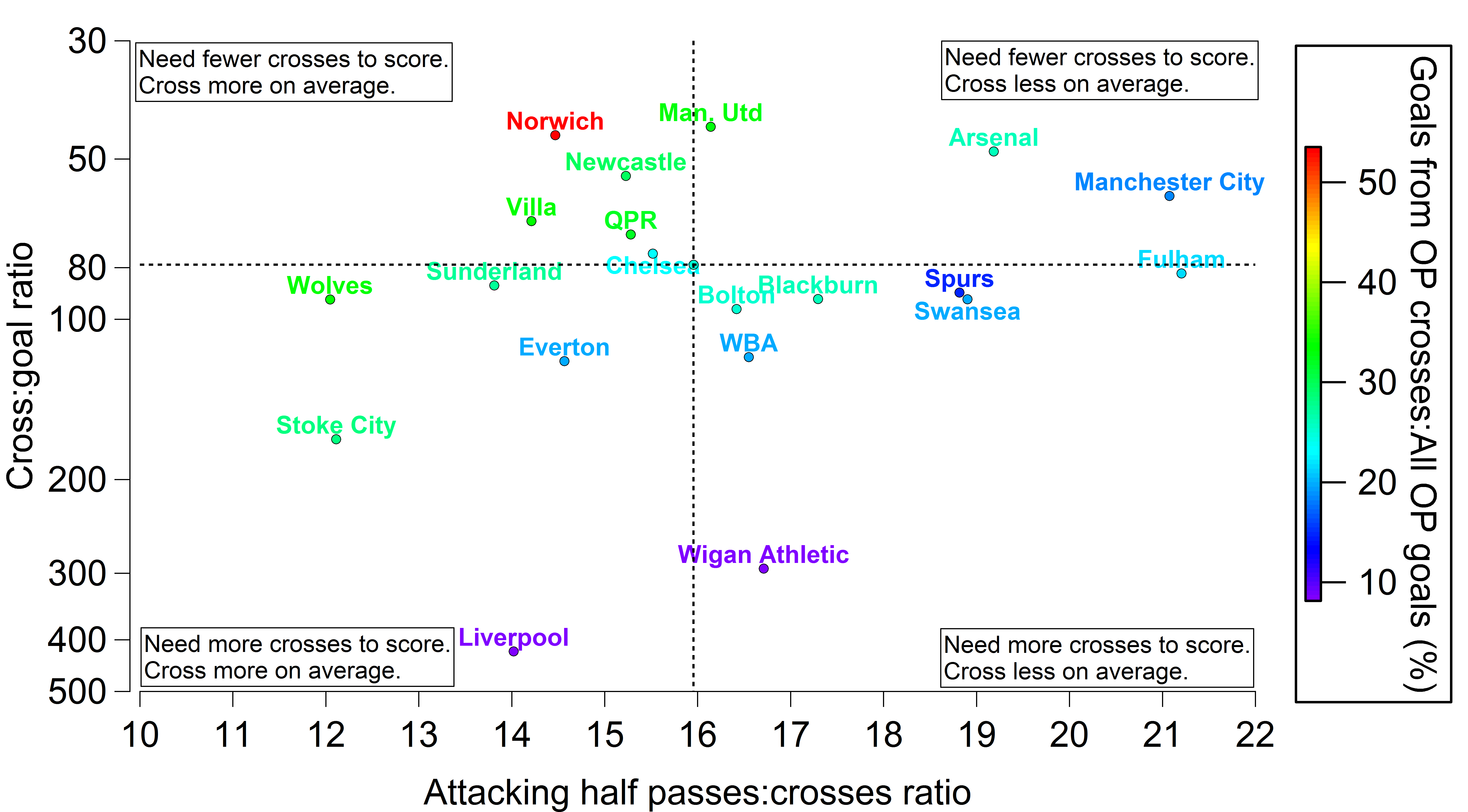
Similarly to this tweet by OptaJoe, I calculated the average number of open-play crosses that each team in the Premier League required to score a goal from an open-play cross last season. This is shown in the graph below versus the number of attacking half passes per open-play cross.

OP Cross goal ratio vs attacking half passes OP cross ratio1 1024x566 A cross to bear: Liverpools crossing addiction | Full League Comparison

Chart above: Relationship between the number of crosses in open-play required to score a goal from a cross in open-play and the number of passes in the attacking half by a team prior to an open-play cross for English Premier League teams in 2011/12. Note that the cross:goal ratio scale is logarithmic and that it is reversed as a larger number is worse. The vertical dashed black line indicates the average number of open-play crosses required to score a goal from a cross in open-play across the league, while the horizontal dashed black line indicates the average number of passes in the attacking half by a team prior to an open-play cross. The teams are coloured by the percentage amount of goals they scored from open-play crosses, relative to their total number of goals in open-play. Data is provided by Opta, WhoScored and EPL-Index.

The analysis indicates that Liverpool did indeed pursue a crossing strategy last season relative to their peers in the Premier League, as they attempted 14 passes in the attacking half prior to attempting a cross. Only Wolves, Stoke and Sunderland played fewer attacking half passes prior to attempting a cross last season. At the other end of the scale, Manchester City and Fulham were relatively sheepish when it came to crossing, attempting just over 21 passes in their opponent’s half prior to attempting a cross. Arsenal, Swansea and Spurs also stood out here, lying more than 1 standard deviation above the league average.

The major issue for Liverpool based on the above analysis was that their conversion from crosses was simply atrocious. They required a staggering 421 open-play crosses to score a single goal in open-play on average last season. This was the worst rate in the whole league, with Wigan the closest on 294. Contrast this with the likes of Manchester United (44.5), Norwich (45.1) and Arsenal (48.4) who were the only clubs to post a value below 50. Furthermore, only 8.3% of Liverpool’s goals in open-play came from an open-play cross. Norwich scored 53.3% of their goals in open-play from open-play crosses

Liverpool seemingly embarked upon a style of play that provided them with a extremely poor return in terms of goals (only 2 goals from an open-play cross all season).

Is crossing the ball an inefficient means of scoring?

The above analysis seemingly demonstrates that Liverpool did indeed pursue a style of play centred around crossing. Liverpool’s apparent quest to show that crossing is an extremely inefficient means of scoring last season (I’m personally still trying to forget those 46 crosses against West Brom at Anfield) potentially clouds the more general question of whether crossing is a tactic worth basing your team around. It could be that crossing can be an efficient way to score but Liverpool were just simply not very good at it.

According to WhoScored, 659 goals were scored in total from open-play, while 241 goals came from set pieces (excluding penalties). The data from Opta show that 166 and 128 goals were scored from open and set-plays respectively. Thus 25% and 53% of all goals in these categories came from crosses. The average number of crosses per goal scored last season was 79 in open-play and 28.3 from a set-piece. Crossing accuracy is also higher for set-pieces (33.9%) compared with open-play (20.5%). This demonstrates that crossing is more effective from set-pieces than in open play.

Crossing the divide

The above analysis demonstrates that Liverpool pursued a playing style overly focussed upon crossing, which yielded very meagre returns. Whether the poor return was a symptom or a contributing factor to their generally poor shot conversion isn’t clear at present and requires further analysis.

The more general question regarding whether crossing is an efficient means of scoring is difficult to assess without more analysis. This study shows that crossing at set-pieces is more efficient than in open-play but to fully answer this question requires comparison with other modes of scoring. The above analysis suggests that structuring your team around crossing in open-play is a very low yield method of scoring, which also results in the loss of possession close to 80% of the time.

Liverpool’s addiction to crossing appears to be a recent trend. In the 3 seasons prior to 2011/12, they averaged 16.4, 15.4 and 15.5 attacking half passes prior to an attempted cross. Swansea under Brendan Rodgers averaged 18.9 last season, which potentially suggests that next season Liverpool will try to kick the crossing habit.


Thanks for rating this! Now tell the world how you feel via Twitter.
What do you think about this post?
  • Excellent
  • Informative
  • Awesome
  • Good Read
  • ok


About the Author

WillTGM
A Liverpool supporting atmospheric scientist who spends far too much time looking at numbers.


Per Mertesacker

The Premier League’s BFG: Per Mertesacker | Arsenal Defender Stats Comparsion

From Steve Bould, Nigel Winterburn and Tony Adams to Kolu Toure, Sol Campbell and William Gallas, Arsenal have never had the shortage of quality defenders in their team. When Arsenal went an entire season unbeaten in 2003-04...
by Samved Bharadwaj
1


England Strikers

Who should partner Rooney for England? Carroll, Sturridge, Defoe & Welbeck compared

England’s squad for their summer friendlies with the Republic of Ireland and Brazil were revealed yesterday and the one position that is up for debate more than any is the 2nd striker role. Although there is the possibility o...
by MattEvans
2


2013-05-16 17.05.39

Scouting Report: Arsenal | Stats & In Depth Tactical Analysis

As the 2012/13 Premier League season draws to a close Martin Lewis looks at Arsenal this week in his Scouting Report. Not only will Arsenal supporters find this interesting but Newcastle and maybe even Spurs supporters will wan...
by martinlewis94
2


19 Comments


  1. @8Leg

    “A staggering 421 open-play crosses to score a single goal.” Staggering indeed. So adding some player names, I guess we can say that Downing did his job of getting crosses in, but either they were poor crosses or Carroll and others did a poor job of finishing them. Surely Rodger’s 4-3-3 has to improve things?


    • I avoided adding in player names for now but will hopefully take a look at that in the future. Liverpool’s crossing accuracy in open-play was below average overall so that could be one part. Unfortunately, I don’t have the data for how many chances were created from crosses, which would be the next step in the chain and then yes you have the likes of Carroll/Suarez not finishing them off.

      I expect that we’ll not see as much crossing under Rodgers, so maybe that will help things. I doubt Rodgers will be keen on the loss of possession that often results from crosses.


  2. Statto

    Staggering seems to be the word – 421 seems to be the number. The “staggering 421″ crosses Liverpool threw at opponents to score a goal. You have to ask the question did the management of Liverpool not realise – erm this isn’t quite working let’s try to play the ball through them for a few games? Might have had better results than trying to convert these crosses. What would be even more interesting is the times that Liverpool failed to beat the first defender – a stat we don’t have at this time!


    • Yes, I would like to look at this game-by-game and include Kenny’s half season in 2010/11 to see when this really started to take-off.

      Through-balls are an interesting one…got something in the works on that so watch this space!


  3. matt

    How would the following passage of play be recorded in the above analysis:

    From open play a team crosses the ball into the box. A defender beats the attacker to the ball and heads it behind for a corner.

    So is this a loss of possession as the striker didn’t get on the cross? What happens if the attacking team is really good at set pieces esp corners, and in the above piece you say the data shows that crosses from set pieces are more likely to provide scoring opportunities.

    It could be theorised that a team playing to cross the ball more has the ball in wide areas more often, near to the goal line and forces more corners as a result, whether the cross is put behind or just blocked for a corner. If they have a long throw specialist then even throw ins near the corner flag are a danger.

    I think its a bit of a stretch to say that crossing is inefficient as a method of scoring. Man Utd built several teams on crossing with Beckham and Giggs providing balls for RVN etc to score from, if they only need 44 crosses to score it suggests that Liverpool just weren’t very good at crossing accurately.


    • Hi Matt,

      Good points. You are correct about a theoretical team gaining a large number of set-pieces via playing it wide. I purposefully left out set-pieces because the efficiency is so different. Liverpool were decent at these, just above average and scored 9 goals from set-piece crosses last season. I wanted to narrow down how a team approaches crossing in open-play as it is so distinct from set-play in both general football terms and as far as the data is concerned.

      I didn’t say that crossing is an inefficient method of scoring. I said that crossing from set-plays are more efficient than crosses in open-play. You can clearly be very good at it (e.g. Norwich) and it will provide you with a lot of goals. Man Utd are also a good example as they are good at it but don’t focus on it in the above analysis.

      What I will say is that even if you are really good at crossing in open play, you’ll on average, get 1 goal every 2-3 games. I’m not convinced that is an efficient method to structure a side around to be successful in the long-term, especially at the highest level.

      Cheers.


  4. LFC_Fan

    Fantastic analysis, only thing missing is the quality aspect, which actually can’t be measured in numeric. I think, we had an extremely poor season last time, because of the wrong strategy & poor execution.

    I don’t think in today’s football, one can build a team only on long ball, sky hoof strategy, which KD tried & purchased player for that. Also, his purchase to execute the strategy was flawed, though he spent hell lot of money. Downing, Henderson & Carroll are at best average in their task, though were purchased for at least twice. Neither of our wingers were Beckham, Ginola or Waddle, nor AC is somewhere near to Van Niestolroy or Bierhoff when it comes to heading.


  5. shuddertothink (bitter and blue)

    ‘it is possible that the figures could be skewed by how much of the ball a particular team has on average. For example, Wolves had much less of the ball than Manchester United last season but attempted a similar number of crosses. This suggests that Wolves were keener to attempt crosses than Manchester United’

    Hi Will, I did a little analysis, Danny may be posting my numbers on bitter and blue shortly.

    I was looking specifically at possession to crosses, I didn’t include passes or any other measures.

    What it showed was that as possession decreased from team to team that team were crossing more.

    Crosses are a specific tactic of the poorer possession teams, the last resort tactic seems to be true. A poorer possession team will attempt more crosses per 1% of their possession than a high possession team will.

    I have done crosses against expectancy and again the higher average possession teams are below expectancy and the poorer teams are above expectancy.

    Only 3 out of 10 top possession teams crossed more than their individual possession number expected. MUFC LFC and WWFC

    7 out of 10 poorest possession teams crossed more than expectancy (Newc, Bol, Bla were the odd teams out)


  6. @mattin_b

    Great stuff! I haven’t watched Liverpool enough to say that the following thoughts are the fact, but I have a feeling that not only poor delivery and the strikers’ incapability to score are the reasons why they didn’t score more on crosses. I think that teams relying on crosses should have midfield players that constantly runs into the box to provide another option for the deliverer. Such a player is much harder to mark and will also decrease the defenders’ focus on Carroll et al.
    Remember how Paul Scholes always was an option when Beckham delivered his magical crosses for Man Utd.


  7. SteveB

    I’m pretty sure Liverpool won more corners than any other team last season so that’s a plus. Anyone any idea what percentage of corners come from cleared crosses compared with blocked shots/saves?


  8. andy

    A couple of you have touched in it already with comments relating to midfielders making runs into box. I believe that the number of players in the box from attacking team would have a massive impact on cross success rate. It’s not just about cross accuracy. Liverpool didn’t get enough men into the box to make the crossing strategy successful, even when pressing for a win. How many times have we seen Man U getting late goals by putting pressure on teams by getting loads of players in the box an putting loads of crosses in? Any analysis of how successful crossing as a strategy is needs to consider this.


  9. Ben Qualtrough

    This theory of shaping the team to cross in order score goals was blatant in Liverpool’s approach last year, which is why we set up with two overlapping full backs and two wide players who looked to cut in and deliver – thus having two options from each flank at all times. It clearly didn’t work and often resulted in the ball being rushed into the box without thought. Two interesting areas to review maybe the number of crosses that were cleared by the first man (defender) – as this appeared to happen frighteningly often and would have obviously resulted in a lower conversation rate, as an effort on goal didn’t follow. Secondly, as this system was devised on the back of signing Andy Carroll; what was Newcastles crosses/goal ratio in the previous season(s) – did it justify preparing such as system at Liverpool?


Leave a Reply

Your email address will not be published. Required fields are marked *


− 1 = six

You may use these HTML tags and attributes: <a href="" title=""> <abbr title=""> <acronym title=""> <b> <blockquote cite=""> <cite> <code> <del datetime=""> <em> <i> <q cite=""> <strike> <strong>