
Welcome to Liverpool Football Club Mr. Brendan Rodgers. To say the Northern Irishman has had a meteoric rise through the managerial football ranks is akin to stating: “Messi, that boy’s decent”. An understatement of epic proportions. But somehow, through hard work, perseverance, and total belief in a footballing philosophy, Rodgers has managed to nab himself one of the most revered jobs in world football. First off, let us look at the timeline of how Rodgers ended up at Liverpool FC.
How Brendan Rodgers Arrived At Liverpool FC
1991 – Studies coaching badges at Reading and works his way up through youth system, eventually being appointed youth team manager
2004 – Scouted by Jose Mourinho and appointed Chelsea youth team manager
2006 – Gets in-house promotion to reserve team at Chelsea
2008 – Leaves Chelsea to become Watford manager. Watford end up finishing 13th in the Championship
2009 – Resigns from Watford position and becomes Reading manager. Sacked after 6 months in the job due to very poor results
2010 – Becomes new Swansea manager and gets them promoted to the Premier League through the play-offs
11/12 – Takes Swansea to an 11th place finish in the Premier League, amassing 47 points in the process
2012 – Appointed Liverpool Coach
Origins of Pressing
But what of that footballing philosophy we so often hear of? My colleague has all ready posted a fantastic piece here on how Brendan Rodgers implements his brand of tika-taka and how the current Liverpool FC squad is likely to fit into that style of football. And to be honest there is not much more I can add to that part of it. However, what of this pressing game we hear of?
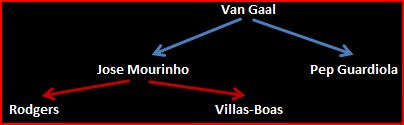
Firstly it’s a tactic/philosophy that is linked through successive coaches. From Van Gaal, through his understudy’s Jose Mourinho and Pep Guardiola, and again passed down to two more disciples under Mourinho, Brendan Rodgers and Andres Villas-Boas. It is no coincidence that these coaches are all linked in some way or another. And it is an insight into how this type pressing game has evolved.
Some of the (lazy) comments I currently read on social media and in newspapers in relation to Swansea’s passing game are: ‘they pass for passing sake”, “they only pass backwards, and sideways” etc. Like there is no plan behind it. But that is doing Rodgers style of football a great injustice and is demeaning to the man’s footballing intelligence.
Mostly, in Rodgers case, the reasons for passing backwards and sideways are purely tactical. Sometimes you need to recycle the ball for long periods in order to recover. Other times, it’s to create angles for passes, and to dominate the opposition.
“When going forward, the best way to move the ball up the field is to create angles of diagonal pass. If you have two banks of four across defence and midfield there are no diagonal passes on. The system needs to be more fluid.” Brendan Rodgers
It is also used as a form of defence. Of course, if you have possession of the ball, then, simplistically the opposition cannot score. Furthermore, the belief is, if you have possession of the football, then the opposition are expending more energy trying to hunt you down and retrieve it. Death by a thousand passes if you will. But how does it work? How does one know when to press or not?
What Rodgers says about pressure:
“The only time we rest is when we have the ball. When we haven’t got the ball is the moment for intense pressure to get the ball back. But you can’t go for 90 minutes, so in order to recuperate and conserve energy, we’ll do that sometimes by building our way through the game.”
What is interesting about that quote is: ‘when we haven’t got the ball is the moment for intense pressure to get the ball back’.
The Six Second Rule
This is based on the principle that when a player regains or receives possession he as at that moment, or for a few seconds, is vulnerable to being dispossessed.
But, and this is crucial, if you cannot win the ball back within those 5 or 6 seconds then you must recognize as a team that you can’t run around pressing the ball for 90 minutes. It’s just not physically possible. So you retreat, regain your defensive shape, and wait for the ‘signs’ to start pressing again.
“You cannot go (press) on your own,” he says. “You work on zonal pressure, so that when it is in your zone, you have the capacity to press. That ability to press immediately, within five or six seconds to get the ball, is important. But you also have to understand when you can’t and what the triggers are then to go for it again because you can’t run about like a madman.” Brendan Rodgers
The ‘Triggers’ For Pressing
Why can a player be vulnerable to losing possession immediately after he receives the ball? Well his overview of the entire pitch becomes limited due to him having to make a tackle, interception or other to win the ball back. If he receives the ball from a stray pass then he may also need to look down at the ball to control it, and again lose his overview of the pitch. This is one of the precise moments when you should apply your pressing game.
A further trigger to start pressing; if the opposition player with the ball needs to turn back towards his own goal. His options become very limited, he can’t pass forward to a teammate, and his vision of the field ahead of him becomes obscured, so it’s at that moment you apply intense zonal pressure on the vulnerable player.
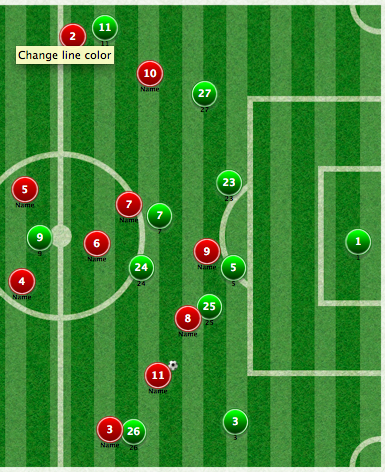
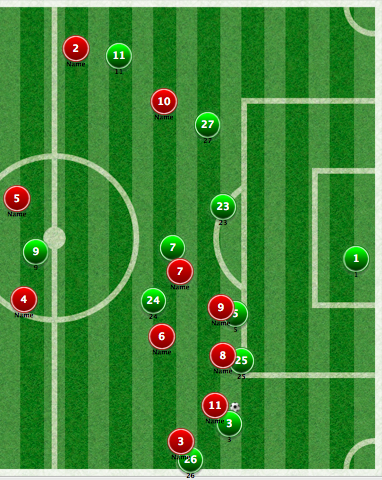
If you take a look at the graphic below you can see how limited the number 3’s (green) options are with pressure applied. There are very few passes on except maybe back to his goalkeeper. So the player is left with either pass it back to his goalkeeper or hoof it up the pitch where there is a high possibility in giving it straight back to the opposition.
As an aside, consider why the great passing players are in fact great; (Alonso, Xavi, Pirlo), if you watch them closely, control of the ball is secondary. They barely look down to see where the ball is, enabling them to have a constant view of what’s going on around them. Vision of your team-mates positions around you is a critical attribute to have in your locker in the modern game.
Team Shape
Not only is the player who receives the ball vulnerable, but also the entire team. It is the transition phase of the ball: the opposition’s defensive shape has not been set. Thus they are, for maybe 5 or 6 seconds susceptible to intense zonal pressure from the opposition.
There is also another factor to consider.This high pressing allows you to win the ball back closer to the opposition goal.
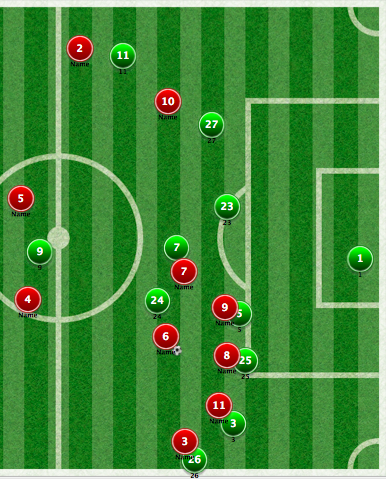
You can see from the graphic used above, how high the attacking team (red) are up the pitch after winning possession. The forward thinking options for red number six, with the ball, are: slip to number 7 who may have an option to shoot, or number 9 can pull of the back of his marker (number 5) and have a route to goal. These are the decisions that you must take immediately after regaining possession. You win it back, and you decide on whether there is a route to goal, if not, you pass it back, recycle possession, and start all over again.
Of course, knowing when to press, in zones, and as an entire team is not something that is normally second nature. It must be taught on training ground. It takes footballing intelligence and tactical discipline. Your team and your players need to be in the right positions the moment is upon you to press. One player pressing the ball is futile, it expends needless energy and almost never works.
And this may be an area where Liverpool struggle in the early part of the season. Knowing when to press and when not to press. It will be fascinating to watch. However, if Brendan Rodgers can get the Liverpool players to understand this important tactical discipline, then the fruits of that knowledge will start to grow and we may start seeing a very exciting new era at Anfield.


Often, drugs that are high in price could have savings and deals that go
with them.