
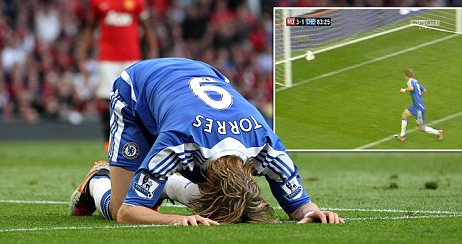
Last weekend, after Arsenal lost against QPR, many Gooners might have shared a wistful moment reminiscing the chance Robin van Persie missed. Those who don the blue of Chelsea probably look back at this Torres miss early in the season and wonder if everything would have been different had that gone in and led to a comeback against United. The Kop faithful will undoubtedly feel their side can win any argument regarding missed opportunities. Indeed, almost every single football fan, irrespective of the club they support and their position in the League, must have had a Redknappesque “my old woman could have scored that” moment at least once during this season.
There are few moments in a game more frustrating than a player missing a gilt-edged opportunity. Unfortunately, we don’t have enough fact-based analysis of such incidents and usually just have to go with clichéd opinions from commentators like, “You’d have put your money on him scoring that”, or “That’s a rare miss from [player name]”, and so on. It’s probably one of the reasons why many fans find football punditry hard to digest.
To an extent we can’t blame anyone because there just aren’t enough facts available as far as clear-cut chances are concerned. There are so many variables involved that it would be hard to find a concise and practical definition that pleases everyone.
One would have to look at so many factors when analysing a clear-cut chance (CCC):
- the distance from goal
- the technique of the player to whom the chance falls
- whether it’s on his stronger or weaker foot; or his head
- attacker’s body shape and orientation
- height of the ball
- condition of the pitch
- positioning and quality of the defenders and the goalkeeper
- pressure applied by the defender(s)
- the weight on the pass
And so on. This article on StatDNA and this one on Arsenal Column provide very interesting discussions on the topic while highlighting the complexities involved.
Opta do provide numbers for clear-cut chances created and converted. In their own words this is one of the “subjective stats” that they offer. Since the definition is not, er, clear-cut, we probably cannot form any definitive opinions but assuming consistency on the part of those recording the stats, maybe one can attempt to create an engrossing discussion on the subject.
Please note that the stats used in this article were compiled prior to the weekend’s fixtures and only include numbers from the first 30 matches.
Let’s start with total clear-cut chances created and converted by each team and their relationship with total goals scored. In the figure below, the blue line represents total gilt-edged chances created by each team while the red one charts the number of these chances that were converted. Total goals scored by a team is in green.

With a single glance it is apparent that these curves are very similar. Most of us, even without any statistical background, can guess there must be strong correlation between the numbers.
The peaks represent sides that are creating and scoring the most. Few will be surprised that the current top four are, in the same order, creating and converting the most clear-cut chances. United, City, Arsenal, and Spurs also form the top four in total goals scored.
At the other end of the table it’s not so simple. For instance, if you look at the last team on the right, Wolves show a steep bump in the red curve indicating a high conversion rate, but not so much in the other two meaning they aren’t creating as many chances or scoring many goals in general.
The other stand-out observations from the graph are,
- Liverpool have created a lot of high quality chances – fifth highest in fact – but are converting very few
- Bolton have not been able to create easy opportunities for their attackers. They’re rock bottom with 26 chances created or less than one per game
- Sunderland have created a lot more chances than Bolton but have converted only 11, joint second-lowest with Bolton
- Wigan are the side that has scored the least number of goals, 10, from so-called sitters
- The average number of clear-cut chances created by the sides is around 53 or 1.77 per game
- United lead the way with 89 and City are close behind with 88 at roughly 3 clear-cut chances per game
- The median for goals scored from such chances falls around 20. Again Man United lead with 40 conversions while Man City have 38.

