

Line-Ups
 Manchester City set out using their experimental 3-4-1-2 system which they have used in pre-season. They had Kolarov and Milner as the players offering the width to the system and up front they had the fluidity and movement of Carlos Tevez and Sergio Aguero, supported by Samir Nasri.
Chelsea set out in their usual 4-2-3-1 which they utilised at the back-end of last season to great effect. Ramires was asked to get forward and drop back as he usually does to great effect, with the flair of Hazard and Mata in behind Fernando Torres.
City’s System
Chelsea struggled throughout the game to cope with Manchester’s three at the back. Having three at the back can be a risky system to use against what is effectively a front three at times (Hazard-Torres-Ramires); however, Chelsea could not work out who should track the wing-backs – should it be the wide forwards, the full backs or the holding midfielders?
With this attacking width, City were able to unsettle the midfield two of Lampard and Mikel and therefore isolate the front two of Tevez and Aguero against the two central defenders.
Another point of confusion occurred in how to deal with City’s numerical advantage in the centre of the pitch. Manchester were able to play out from the back comfortably because they had three central defenders who could spread wide and stretch the forward line of Chelsea, but they still were able to maintain two central midfielders who could drop in and pick up the ball. This meant that either the wide forwards had to tuck in to close this space, opening space for the wing-backs, or City would have a free reign in the centre of the pitch.
In the 15th minute of the game a perfect example of this confusion occurred. Ramires tucked in to close down De Jong on the ball, but he was able to play it safely to Zabaleta. With Ramires now out of position, Kolarov was able to receive the ball in space and had Aguero drifting to the left in support. Lampard dropped deep and tried to help Ivanovic track the two players; but this allowed Nasri space in the centre.
City kept possession and Tevez dropped into the empty space where the holding midfielders should have been. John Terry followed Tevez which left space at the back and City had both Aguero and Nasri running in behind. It didn’t result in a goal but it proved a warning to Chelsea, who could not deal with the system of Manchester City (shown in the three images below).


Chelsea Goal
Chelsea scored with what really was the first time they had exposed a three on three situation at the back. It was a somewhat fortuitous goal but Torres finished drifted into space and finished well. The goal came after a quick counter by Chelsea.
City had won the ball back and were looking to transition quickly; however a long diagonal switch left to right by Nasri was cut out by Cole, leaving him space to run at Savic. Ramires came inside and beat a player before looking for a 1-2 with Hazard but the ball fell to Torres who tucked it home.
That goal was the catalyst for an eventful end to the first half. Almost immediately Chelsea worked another move which worried the City back three and Savic was lucky to not receive a second yellow for checking Torres’ run.
Then a rash tackle from Ivanovic resulted in a straight red card and Chelsea had to reshuffle their system. This changed the game in City’s favour – Chelsea had already struggled with dealing with the wing backs, and now had to do so with one less player on the pitch.
Second Half Changes
 Di Matteo resorted to dropping Ramires to right back and Mata on the right in a deep 4-4-1. This system had worked effectively at the Nou Camp but here City were able to maintain their width and stretch the Chelsea defence (unlike Barcelona who were content trying to play narrowly through Chelsea’s deep line).
City made a substitution by removing the shaky Savic, replaced by Clichy, and pushing Zabaleta to the right of the back three.
Manchester City’s Goals
City equalised through Toure – but the goal came again from the confusion and lack of communication in picking up the wing backs.
Here, Cole at left-back had tried to stay close to Milner, but when Terry follows Aguero into the midfield and Nasri runs in behind, Cole realised he had to tuck in. In doing so he turned his back on Milner, who received the ball and had time to cross. A poor clearance from Terry fell to Toure who finished past Cech.

The second goal was a bit of brilliance from Tevez but started with the ball being played to Kolarov and the midfield two of Lampard and Mikel pushing too far across allowing Tevez space to run across the face of the back four and shoot.
Similarly, City’s third came from exposing the wide areas. This time Tevez drifted to the left and Kolarov supported. Ramires was helpless in this 2v1 situation and Kolarov was able to get a cross in. In the box, Luiz had ball watched by moving into the front post zone, but had failed to track Nasri who had dropped off for the cut back on the six-yard box and he was able to finish unopposed.
Chelsea were able to get one goal back – via a goalkeeping fumble – but didn’t really deserve to finish the game only one goal behind.
Conclusion
This match was definitely a victory for Mancini’s system. By playing with two proactive wide players in Kolarov and Milner, Chelsea were unsure on who should pick up their runs. Also, by playing with three at the back, City were able to play an attacking midfielder off the front two whilst still maintaining two deeper midfielders and substantial width.
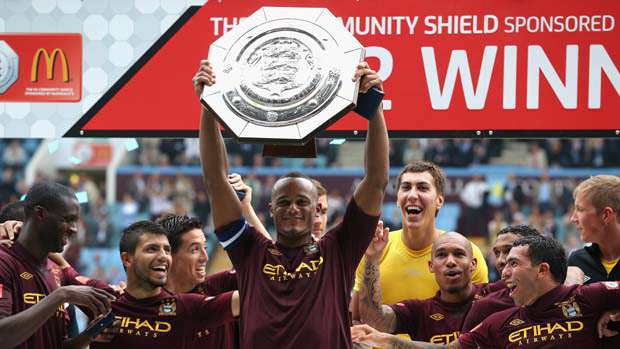
Even without the sending-off Chelsea would have struggled with the system employed by City – who have deservedly won their first piece of silverware for the season; and, if they maintain this system it won’t be the last.

)